


CRM Data Quality: Measure It With a Scorecard
How to measure CRM data quality with a few meaningful metrics, build a monthly scorecard and turn the numbers into action.
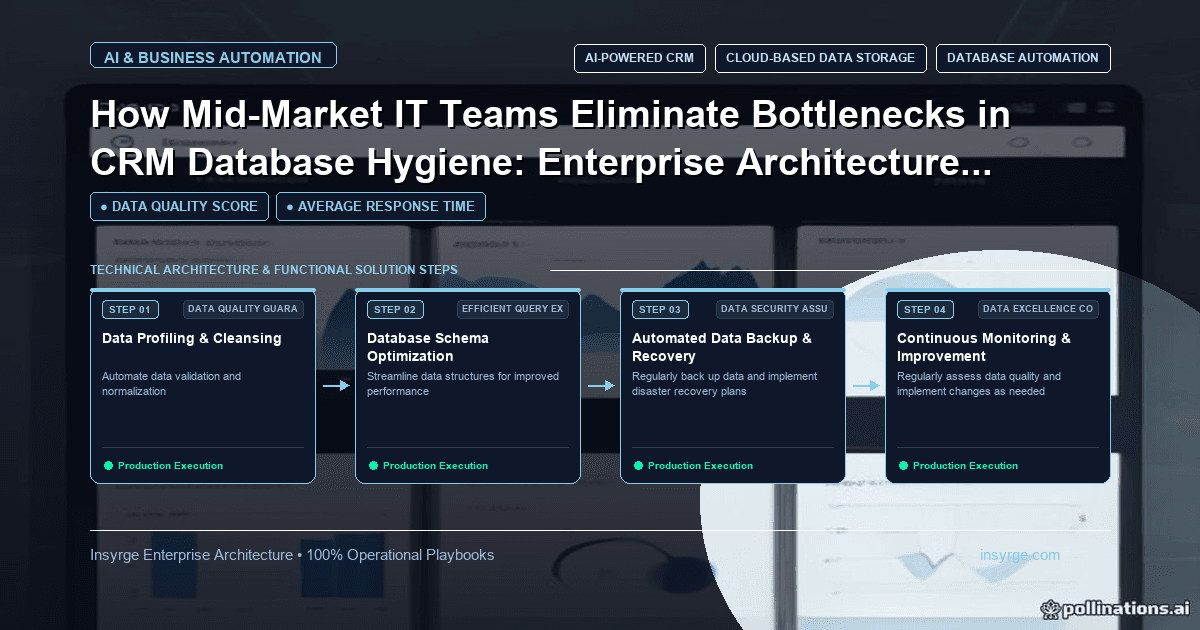
Measure CRM data quality with metrics that matter: completeness, validity, uniqueness and freshness, a monthly scorecard and sampling for accuracy.
Everyone agrees that CRM data should be "good", but few teams can say how good it is today, whether it is improving, or which problems cost them most. Without measurement, data quality work becomes a series of reactive clean-ups triggered by an embarrassing report or a failed campaign. CRM data quality becomes manageable when you define what quality means for your business, measure it with a handful of clear metrics, show the results where people see them and assign owners to fix what the numbers reveal. This guide explains the dimensions of data quality, which metrics matter for a B2B CRM, how to build a scorecard and how to act on it, with a worked example.
 The dimensions of CRM data quality
Data quality is usually described through a few dimensions. For a CRM, six matter most:
DimensionQuestion it answersExample measureCompletenessAre the fields we need filled in?Share of accounts with industry and countryValidityDo values follow the agreed format and allowed list?Share of phone numbers in the standard formatUniquenessDoes each real-world entity appear once?Estimated duplicate rate for contactsAccuracyDo values reflect reality?Share of sampled contacts whose job title is still correctTimelinessIs the data current?Share of open deals updated in the last 30 daysConsistencyDo related records agree?Contacts whose account country differs from their own
You do not need to measure everything. Choose the dimensions that affect the decisions and processes you care about.
Choosing metrics that matter
Start from how the CRM is used, then work back to the fields:
- Lead routing depends on country, industry and company size, so measure their completeness and validity
- Outreach depends on valid emails and phone numbers, so measure deliverability and format
- Forecasting depends on deal amounts, stages and close dates, so measure completeness and timeliness on open deals
- Account management depends on unique accounts with correct owners, so measure duplicate rates and orphaned records
A metric earns its place when a change in it would change what someone does. "Percentage of all fields filled" fails that test; "percentage of new leads with country and industry" passes it.
Building a CRM data quality scorecard
A scorecard brings the metrics together with targets and owners. Keep it short, around eight to twelve measures, and refresh it automatically, weekly or monthly. Each line should show the current value, the target, the trend and the person responsible. Group measures by business process, such as routing, outreach and forecasting, so leaders see why each matters.
Some measures can be calculated automatically from CRM data. Accuracy usually needs sampling: check a small random set of records by hand each month, such as twenty contacts against their company websites, and record the share that were correct.
Worked example: a monthly scorecard from a CRM export
Suppose a B2B company wants a monthly data quality scorecard. A short script calculates automated measures from exports of contacts, accounts and deals. It is illustrative and untested; column names follow a typical export and would need adjusting.
import pandas as pd

contacts = pd.read_csv("contacts.csv")
accounts = pd.read_csv("accounts.csv")
deals = pd.read_csv("deals.csv", parse_dates=["Closing_Date", "Modified_Time"])
today = pd.Timestamp.today()

def pct(series):
    return round(100 * series.mean(), 1)

open_deals = deals[~deals["Stage"].isin(["Closed Won", "Closed Lost"])]
scorecard = {
    "Accounts with industry and country": pct(accounts["Industry"].notna() & accounts["Billing_Country"].notna()),
    "Contacts with valid-format email": pct(contacts["Email"].str.contains(r"^[^@\s]+@[^@\s]+\.[^@\s]+$", na=False)),
    "Contacts sharing an email (duplicates)": pct(contacts["Email"].str.lower().duplicated(keep=False) & contacts["Email"].notna()),
    "Open deals with amount": pct(open_deals["Amount"].fillna(0) > 0),
    "Open deals with future close date": pct(open_deals["Closing_Date"] >= today),
    "Open deals updated in last 30 days": pct(open_deals["Modified_Time"] >= today - pd.Timedelta(days=30)),
}
for name, value in scorecard.items():
    print(f"{name}: {value}%")
The results go into a dashboard alongside targets and owners:
MeasureThis monthTargetLast monthOwnerAccounts with industry and country71%90%64%Sales operationsContacts with valid-format email93%98%92%Marketing operationsContacts sharing an email4.2%Under 1%4.6%Sales operationsOpen deals with amount88%100%81%Sales managersOpen deals with future close date74%95%70%Sales managersOpen deals updated in last 30 days66%90%63%Sales managersSampled contacts with correct job title78%85%Not measuredMarketing operations
The figures are hypothetical. Reading the scorecard, the company sees that forecasting measures lag most, so sales managers review stale deals in weekly pipeline meetings. The duplicate rate prompts a deduplication run, and the account completeness gap is addressed with enrichment.
Sampling for accuracy
Accuracy is the hardest dimension to automate, because a value can be perfectly formatted and still wrong. A light sampling routine works well. Each month, draw a random sample of records, such as twenty active contacts and twenty accounts, and check key fields against a reliable source: the company website, a recent email signature or a conversation logged by the account owner. Record how many were correct per field. Rotate who does the checking so the routine does not depend on one person, and keep the samples small enough that the job takes under an hour.
Measuring by source
Overall percentages hide where problems come from. Break key measures down by record source, such as web forms, imports, integrations and manual entry. If records from one integration have far lower completeness than the rest, fix that integration before cleaning anything. Adding a source field to every record, if your CRM does not track it already, makes this analysis possible.
Turning metrics into action
A scorecard without action is decoration. For each measure below target:
- Identify the cause: a form, an import, an integration or a habit
- Fix the source first, through validation, integration changes or training
- Clean the backlog second, through deduplication, enrichment or targeted updates
- Recheck the measure next month
Assign one owner per measure, ideally the team that uses or creates the data. Data quality improves fastest when the people entering data see the scorecard and understand why it matters to them.
Making data quality visible
Put the scorecard where people already look, such as a CRM dashboard or the weekly sales meeting. Show trends rather than single numbers, and celebrate improvements. Add record-level views that list the specific records failing each measure, so owners can act directly rather than just seeing a percentage.
Common mistakes
- Measuring everything and acting on nothing
- Using vanity measures such as overall field fill rate
- Calculating metrics once, for a project, then never again
- Ignoring accuracy because it needs manual sampling
- Giving data quality to IT alone, when sales and marketing create most of the data
For fixing duplicates and merging records, see our guide to CRM data hygiene. Data quality is the foundation of predictive scoring, as our guide to AI lead scoring explains.
Frequently Asked Questions
How do we measure CRM data quality?
Choose measures for completeness, validity, uniqueness, accuracy, timeliness and consistency on the fields your processes depend on, then track them regularly against targets.
What is a good CRM data quality score?
There is no universal benchmark. Set targets per measure based on what your processes need, such as near-complete country data if routing depends on it.
How often should we measure data quality?
Monthly works for most teams, with weekly checks on measures tied to fast-moving processes such as lead routing or forecasting.
Who should own CRM data quality?
The teams that create and use the data, with one named owner per measure and a coordinator, often in sales or revenue operations.
Improve your CRM data quality with us
We build data quality scorecards, dashboards and fixes for Zoho CRM, so you know where you stand and what to improve. See our Zoho CRM automation services, or talk to us about your CRM data.
About the Author
Manav Sharma is the founder of Insyrge and a CRM solutions architect. He works across Zoho, Salesforce, HubSpot, Odoo and more, designing the CRM setups, integrations and automations that keep sales and operations teams working from the same data.
Need Help Implementing This in Your Business?
Our certified Zoho consultants and automation experts can help you design and deploy custom workflows tailored to your operations.
Book Free Consultation