


Event-Driven Architecture: When It Fits
How producers, routers and consumers work together, where event-driven design helps and the new problems it brings.
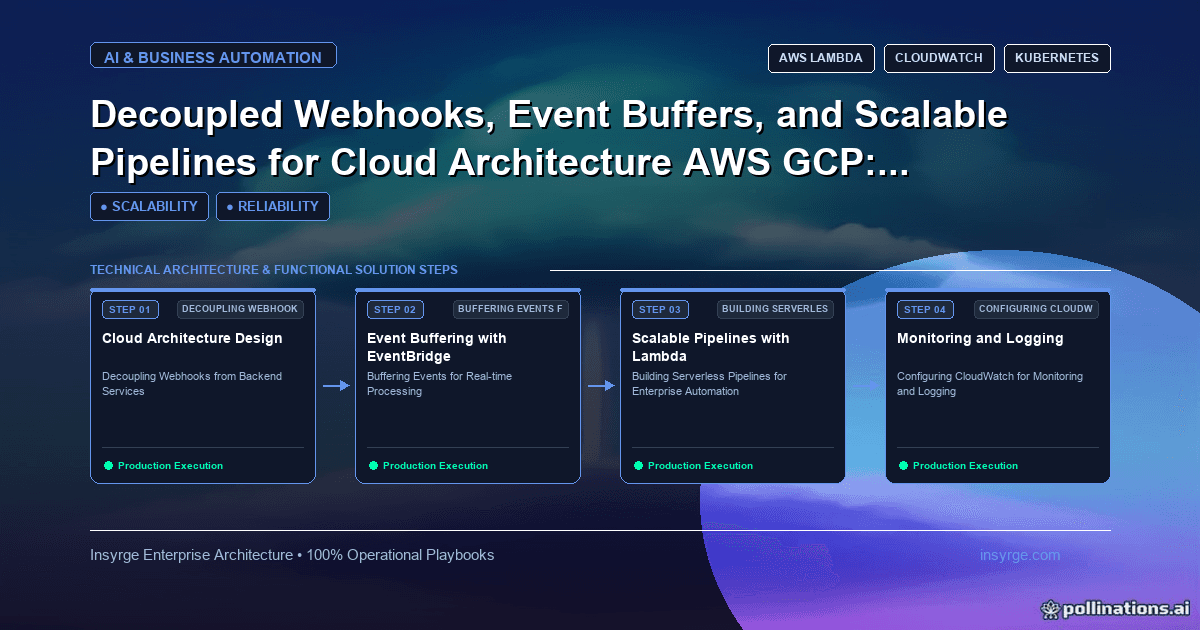
Decide when event-driven architecture fits: how producers, routers and consumers decouple services, plus ordering, duplicates, tracing and schema care.
In many business systems, one action needs to set off several others. When an order is placed, stock must be reserved, an invoice created, a confirmation email sent, the CRM updated and the warehouse notified. The traditional approach is for the order service to call each of these directly, one after another. That works until one of those systems is slow or down, or until a new system needs to be added and the order code must change again. Event-driven architecture takes a different approach: the order service announces that an order was placed, and other services react to that event in their own time. This guide explains how it works, when it fits and the new problems it brings.
 What event-driven architecture is
AWS describes an event-driven architecture as one that uses events to trigger and communicate between decoupled services, and notes it is common in applications built with microservices (AWS: What is an event-driven architecture?). In that description, an event is a change in state or an update, such as an item being placed in a shopping cart. Events can carry the state itself, such as the item and price, or simply identify what changed, such as a notification that an order shipped.
Producers, routers and consumers
According to the same AWS overview, event-driven architectures have three key components:
- Event producers, which publish events when something happens
- Event routers, which filter events and push them to consumers
- Event consumers, which react to the events they care about
Because producers and consumers are decoupled, AWS notes, they can be scaled, updated and deployed independently. The order service does not need to know which systems react to an order, and new consumers can be added without changing it.
When event-driven architecture fits
The approach suits situations where:
- One action triggers several independent follow-up tasks
- Follow-up work does not need to finish before the user gets a response
- Systems owned by different teams need to react to the same changes
- Workloads arrive in bursts that benefit from buffering
- New integrations are added often
For example, sending a confirmation email, updating analytics and notifying a CRM can all happen as reactions to one "order placed" event.
When it may not fit
Direct calls can be simpler and better when:
- The caller needs an immediate answer, such as checking stock before confirming an order
- Only one system is involved and that is unlikely to change
- The team is small and the added infrastructure would be hard to maintain
- Strict, immediate consistency between systems is essential
Many systems combine both: direct calls where an answer is needed now, events for everything that can happen afterwards.
Common building blocks
Event-driven systems use components such as:
- Message queues, which hold work for one consumer group until it is processed
- Publish-subscribe topics, which deliver each event to several subscribers
- Event buses or routers, which filter and route events by type or content
- Event streams, which store events in order so consumers can read and replay them
Our guide to webhook queues explains how buffering incoming events protects systems from bursts and outages.
Design events carefully
Events become contracts between teams. Good practice includes:
- Clear names in the past tense, such as order placed or invoice paid
- A consistent structure with an event type, a unique ID, a timestamp and a version
- Only the data consumers genuinely need, avoiding unnecessary personal information
- Documentation of each event's meaning and fields
Changing an event's structure can break consumers, so version events and add fields rather than removing or renaming them.
Handle duplicates and ordering
Messaging systems may deliver an event more than once, and events can arrive in a different order from the one in which they were produced. Consumers should therefore:
- Be idempotent, so processing the same event twice has no extra effect
- Track processed event IDs where duplicates would cause harm
- Avoid assuming strict ordering unless the platform guarantees it for that case
- Use version numbers or timestamps to ignore outdated updates
Handle failures
When a consumer fails to process an event, it needs a plan:
- Retry with backoff for temporary problems
- Move repeatedly failing events to a dead letter queue for investigation
- Alert someone when failures build up
- Make reprocessing possible once the problem is fixed
Worked example: an order event flow
The table below is a hypothetical event flow for an online ordering system. It shows how responsibilities can be split, not a specific product design.
EventProducerConsumersConsumer actionIf consumer failsOrder placedOrder serviceInventory, billing, email, CRM syncReserve stock, create invoice, send confirmation, update CRMRetry, then dead letter queue and alertPayment confirmedBilling serviceOrder service, fulfilmentMark order paid, start pickingRetry, alert finance after repeated failuresOrder shippedFulfilment serviceEmail, CRM sync, analyticsSend tracking email, update CRM, record metricsRetry; email can be resent laterOrder cancelledOrder serviceInventory, billing, CRM syncRelease stock, issue refund, update CRMRetry, manual review for refunds
Coordinate multi-step processes
Some business processes span several services and must either complete or be undone. The saga pattern handles this with a sequence of local transactions and compensating actions. Our guide to workflow orchestration covers when to coordinate steps centrally and when to let services react to events.
Make the system observable
Event-driven systems can be harder to follow, because a single action spreads across many services. Add a correlation ID to each event so you can trace everything that happened as a result of one order. Monitor queue lengths, processing delays, failure rates and dead letter queues. Without this, diagnosing problems becomes guesswork.
Consider the operational cost
Message brokers and event buses are additional systems to run, secure and monitor, even when managed by a cloud provider. Factor in the skills and time needed. For a small application, a simple queue for background jobs may provide most of the benefit with far less complexity.
Introduce events gradually
You do not need to redesign everything at once. Start with one clear case, such as moving confirmation emails and CRM updates out of the order request path into event consumers. Learn from that before expanding, and write down the conventions you settle on so later events follow the same pattern.
Frequently Asked Questions
What is event-driven architecture?
It is a design in which services communicate by publishing and reacting to events, such as an order being placed, rather than calling each other directly.
What are the main components of an event-driven architecture?
Event producers publish events, event routers filter and deliver them and event consumers react to the events they need.
When should event-driven architecture be avoided?
When the caller needs an immediate answer, only one system is involved, strict immediate consistency is essential or the team cannot support the extra infrastructure.
How do consumers handle duplicate events?
By being idempotent, tracking processed event IDs where needed and ignoring outdated updates using versions or timestamps.
Decouple your systems where it helps
We design event flows, queues and consumers that make business systems easier to extend and more resilient. See our custom app development services, or talk to us about event-driven architecture.
About the Author
Manav Sharma is the founder of Insyrge and a CRM solutions architect. He works across Zoho, Salesforce, HubSpot, Odoo and more, designing the CRM setups, integrations and automations that keep sales and operations teams working from the same data.
Need Help Implementing This in Your Business?
Our certified Zoho consultants and automation experts can help you design and deploy custom workflows tailored to your operations.
Book Free Consultation